

Sensor Fusion Market to Reach USD 28.63 Billion by 2035 at 11.6% CAGR
Sensor Fusion Market
Sensor Fusion Market Size, Share & Industry Analysis By Technology (Software based, Hardware based, Hybrid systems), By Application (Automotive, Aerospace
Sensor Fusion Market: The Sensor Fusion Market is growing as connected systems combine data from multiple sensors to enable smarter, more accurate, and real-time decision-making.”
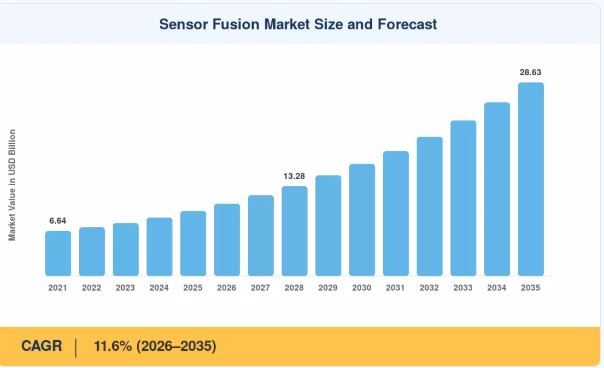
BERLIN, BERLIN, GERMANY, August 12, 2026 /EINPresswire.com/ -- The Global Sensor Fusion market reached an estimated USD 9.55 billion in 2025 and is projected to grow from USD 10.66 billion in 2026 to USD 28.63 billion by 2035, registering a CAGR of 11.6% during the forecast period. This expansion is anchored in the accelerating deployment of advanced driver-assistance systems across the automotive industry and the parallel proliferation of smart infrastructure programs funded by governments worldwide. — Market Research Future (MRFR)
The European Commission's Horizon Europe initiative alone channeled over EUR 1.2 billion toward intelligent transport systems between 2021 and 2024, directly fueling demand for integrated perception platforms. The market's 11.6% CAGR reflects the convergence of ADAS and autonomous driving mandates (+2.8% impact), solid-state lidar cost deflation (+2.1%), smart city and connected infrastructure programs (+1.7%), and edge-AI and on-chip fusion processing (+1.5%) accelerating across the world's largest automotive and smart-infrastructure economies simultaneously.
A fundamental technology shift is underway across the market. Legacy standalone sensor architectures where radar, cameras, and inertial measurement units operated in isolation are giving way to centralized fusion platforms that process heterogeneous data streams in real time. Automakers and tier-one suppliers invested an estimated USD 4.8 billion in perception-stack R&D during 2024, and regulatory mandates such as the EU General Safety Regulation, which requires intelligent speed assistance and lane-keeping systems on all new vehicles sold after July 2024, have compressed adoption timelines considerably.
Asia-Pacific commands the largest share of the market at approximately 37% of global revenue, driven by China's aggressive autonomous driving roadmap and Japan's industrial robotics sector. The Middle East & Africa region is the fastest-growing region, posting a forecast CAGR of 14.2%, propelled by smart city mega-projects in Saudi Arabia and the UAE. North America holds the second-largest position, accounting for roughly 29% of revenue, underpinned by defense-sector investment and Silicon Valley's autonomous vehicle ecosystem.
Get Full PDF Sample Copy of Report: (Including Full TOC, List of Tables & Figures, Chart) @
https://www.marketresearchfuture.com/sample_request/1696
➤ How Significant Is the Sensor Fusion Market's Growth?
The sensor fusion market's trajectory from USD 9.55 billion in 2025 to a projected USD 28.63 billion by 2035 represents nearly a three-fold expansion over the forecast decade, reflecting the structural shift from decentralized, single-sensor perception toward centralized fusion platforms that consolidate radar, camera, lidar, and inertial data into unified real-time scene understanding. The market's 11.6% CAGR is anchored in a regulatory-and-technology supercycle where ADAS safety mandates, solid-state lidar cost curves, and edge-AI compute are all converging to make sensor fusion a mandatory, rather than premium-only, capability across automotive, industrial, and defense platforms.
Hardware remains the dominant offering segment, representing approximately 58% of total revenue in 2025, as OEMs continue scaling embedded fusion ECUs across vehicle platforms, while software is the fastest-growing offering segment, forecast to expand at a CAGR of 13.4% through 2035, reflecting rising demand for middleware and algorithm licensing models. By fusion method, Radar + Camera Fusion holds the largest share at roughly USD 4.10 billion in 2025, owing to its mature cost-performance profile in ADAS applications, while Lidar + Camera Fusion is gaining traction rapidly at a projected 14.8% CAGR as solid-state lidar unit costs decline below USD 500. By application, automotive anchors the market with approximately 52% share in 2025, while industrial applications are expanding at a 13.2% CAGR as factory automation and predictive maintenance systems increasingly rely on fused sensor data.
➤ What Does the Future Hold for the Sensor Fusion Market?
ADAS and autonomous driving mandates contribute approximately +2.8 percentage points to the sensor fusion market's CAGR the single highest driver impact. The European Union's General Safety Regulation, effective July 2024, mandates that every new vehicle sold in the bloc include intelligent speed assistance, drowsiness detection, and emergency lane-keeping, all of which require fused radar-camera perception stacks. In the United States, NHTSA's finalized rulemaking on automatic emergency braking effectively requires forward-facing sensor fusion as standard equipment across all light-duty vehicles by model year 2029.
Solid-state lidar cost deflation contributes approximately +2.1 percentage points to the CAGR, establishing lidar-camera fusion as an increasingly mainstream architecture. First-generation mechanical lidar systems were priced above USD 10,000 in 2020; by late 2024, Hesai and Luminar were shipping solid-state devices in the USD 400–600 range, with industry estimates expecting prices to cross USD 200 by 2028, making lidar + camera fusion economically feasible for mid-market passenger vehicles rather than premium-only applications. Smart city and connected infrastructure programs add a further +1.7% to the CAGR, with Saudi Arabia's NEOM project and the UAE's Dubai 2040 Urban Master Plan committing a combined USD 3.2 billion to sensor fusion platforms for roadside and vehicle-mounted applications, reinforced by South Korea's K-City autonomous testbed and Singapore's Intelligent Transport System roadmap.
The next phase of the market's evolution centers on AI-native perception architectures, where transformer-based models already demonstrating superior performance in bird's-eye-view perception tasks will consolidate radar, camera, and lidar inputs into unified latent representations; NVIDIA estimates its next-generation DRIVE Thor platform will deliver 2,000 TOPS of AI compute, enabling real-time fusion of 20-plus sensor inputs simultaneously.
The global transition to electric vehicles is also restructuring OEM demand, with software-defined vehicle architectures centralizing perception processing on high-performance compute platforms as the IEA projects EV sales reaching 45 million units annually by 2030. Defense and national security applications will sustain long-cycle demand through 2035, as the U.S. Department of Defense's Replicator initiative aims to field thousands of autonomous systems requiring real-time multi-spectral fusion, alongside combined European defense spending that reached a record EUR 326 billion in 2024.
Get access to the full description of the report @
https://www.marketresearchfuture.com/reports/sensor-fusion-market-1696
➤ Who Are the Key Players in the Sensor Fusion Market?
The sensor fusion market exhibits medium concentration, with the top five players collectively holding an estimated 35–42% revenue share. The competitive landscape spans semiconductor companies, automotive tier-one suppliers, and pure-play perception software firms, with an estimated Herfindahl-Hirschman Index of approximately 650–800 indicating a moderately fragmented market where innovation speed and OEM relationships determine positioning more than scale alone. MRFR identifies the following key participants with estimated revenue share ranges:
Robert Bosch (~8–11% share) - a vertically integrated tier-one supplier with global OEM reach providing radar-camera fusion modules and ADAS ECUs, shipping millions of integrated perception modules annually across mass-market vehicle programs.
Continental AG (~7–10% share) - a full-stack ADAS supplier pursuing a software pivot, offering surround-view fusion and advanced radar sensors, having partnered with Ambarella to co-develop a centralized ADAS fusion domain controller for L2+ and L3 applications.
Aptiv (~5–8% share) - a software-defined vehicle architecture leader providing Smart Vehicle Architecture and perception platforms, positioned to decouple sensing hardware from centralized compute for scalable OEM deployment.
Mobileye / Intel (~6–9% share) - a vision-centric fusion specialist with proprietary mapping, providing EyeQ SoCs and the SuperVision perception system that anchors camera-first fusion strategies for both ADAS and autonomous driving programs.
Qualcomm (~4–7% share) - pursuing an SoC-level fusion consolidation strategy through its Snapdragon Ride Flex platform, integrating ADAS and digital cockpit functions on a single chip targeting multiple global OEM production programs by 2026.
NXP Semiconductors (~4–6% share) - an automotive semiconductor specialist providing radar processors and S32 vehicle networking silicon, serving as a foundational supplier across radar-camera fusion module supply chains.
NVIDIA (~3–5% share) - an AI compute platform provider for L3/L4 autonomy offering the DRIVE Thor and Orin platforms alongside Omniverse simulation, targeting real-time fusion of 20-plus sensor inputs on next-generation compute hardware.
Infineon Technologies (~3–5% share) - a power-efficient sensing semiconductor provider offering radar transceivers and AURIX microcontrollers, serving as a core silicon supplier across automotive fusion architectures.
STMicroelectronics (~2–4% share) - a broad sensor portfolio provider for automotive and industrial applications, offering time-of-flight sensors and MEMS IMUs that underpin multi-modal fusion designs.
Texas Instruments (~2–4% share) - an analog and embedded processing foundation provider offering mmWave radar, DLP technology, and signal processors that support both automotive and industrial fusion implementations.
Strategic competition in the sensor fusion market is increasingly defined by proprietary training datasets and real-world driving miles that create defensible advantages pure algorithm innovation cannot easily replicate, with high system integration complexity across radar, camera, and lidar modalities cited as a top adoption barrier, alongside semiconductor supply-chain volatility that has kept automotive-grade chip lead times at 26–30 weeks as of early 2025, data privacy and cybersecurity regulations under the EU AI Act and GDPR adding 8–15% to development budgets, and fragmented standardization across fusion protocols.
➤ What Are the Emerging Trends in the Sensor Fusion Market?
Several transformational trends are redefining the sensor fusion market's evolution through 2035:
ADAS and Autonomous Driving Mandates: The EU General Safety Regulation and NHTSA's automatic emergency braking rulemaking are converting fused radar-camera perception from a premium feature into standard equipment across all new light-duty vehicles by model year 2029.
Solid-State Lidar Cost Deflation: Solid-state lidar prices have fallen from above USD 10,000 in 2020 to the USD 400–600 range by late 2024, with industry estimates expecting sub-USD 200 pricing by 2028, making lidar + camera fusion viable for mid-market rather than premium-only vehicle programs.
Smart City and Connected Infrastructure Programs: Saudi Arabia's NEOM project and the UAE's Dubai 2040 Urban Master Plan have committed a combined USD 3.2 billion to sensor fusion platforms for roadside and vehicle-mounted applications, reinforced by testbed programs in South Korea and Singapore.
Edge-AI and On-Chip Fusion Processing: Platforms like Qualcomm's Snapdragon Ride Flex and NVIDIA's DRIVE Thor consolidate radar, camera, lidar, and ultrasonic processing onto a single chip, cutting latency from 100-plus milliseconds to under 10 milliseconds for safety-critical applications.
Robotaxi and Autonomous Mobility-as-a-Service: Commercialization of robotaxi services in San Francisco, Phoenix, Wuhan, and Shenzhen is creating concentrated demand, with each L4 robotaxi requiring sensor suites worth USD 8,000–15,000 and fleet operators expecting over 100,000 vehicle deployments worldwide by 2030.
Buy Full Research Report:
https://www.marketresearchfuture.com/checkout?currency=one_user-USD&report_id=1696
➤ How Is the Sensor Fusion Market Segmented?
The sensor fusion market report provides a comprehensive segmentation framework:
By Offering: Hardware (~58% share, 2025), Software (13.4% CAGR)
By Fusion Method: Radar + Camera Fusion (USD 4.10 billion, 2025), Lidar + Camera Fusion (14.8% CAGR), Other Fusion Methods (~18% share, 2025)
By Algorithm Type: Kalman Filter — EKF/UKF (~42% share, 2025), Bayesian Networks (13.9% CAGR), Deep Learning / Neural Fusion (USD 1.85 billion, 2025), Other Algorithms (~8% share, 2025)
By Application: Automotive (~52% share, 2025), Industrial (13.2% CAGR), Consumer Electronics (USD 1.24 billion, 2025), Aerospace & Defense (~14% share, 2025), Healthcare (12.7% CAGR)
By Region: Asia-Pacific (~37%), North America (~29%), Europe (~22%), South America (9.8% CAGR), Middle East & Africa (14.2% CAGR)
➤ What Are the Regional Insights from the Sensor Fusion Market?
Asia-Pacific leads the sensor fusion market with approximately 37% revenue share in 2025, with China commanding roughly 44% of regional revenue through its massive vehicle production volume, exceeding 30 million units in 2024, and its Ministry of Industry and Information Technology's roadmap targeting 50% new vehicle penetration for L2+ ADAS by 2025 and conditional L3 by 2030. India is posting a 15.1% CAGR within the region through its Smart City Mission and Bharat NCAP adoption, Japan contributed USD 0.72 billion through DENSO and Hitachi fusion platforms, South Korea holds roughly 12% of regional share through Hyundai-Kia autonomous vehicle programs and Samsung's semiconductor ecosystem, and ASEAN is growing at a 13.6% CAGR through Thailand's EV hub and Singapore's autonomous testbeds.
North America holds roughly 29% of global sensor fusion market revenue, with the United States commanding approximately 78% of regional revenue as the Department of Defense allocated over USD 1.8 billion toward autonomous ground vehicle perception systems in its FY2025 budget, and commercial deployment of Waymo and Cruise robotaxi services continuously refines fusion algorithms through real-world driving data. Canada is growing at a 12.1% CAGR through mining automation and cold-weather ADAS testing corridors, and Mexico contributed USD 0.18 billion through tier-one supplier manufacturing hubs.
Europe accounts for roughly 22% of global sensor fusion market share, with Germany commanding approximately 31% of regional revenue as its automakers collectively spent over EUR 2.5 billion on ADAS and autonomy R&D in 2024. The UK is growing at an 11.5% CAGR through Connected and Autonomous Vehicle Centre funding, France contributed USD 0.35 billion through Valeo and Stellantis R&D investment, Italy is posting a 10.8% CAGR through industrial automation in the Emilia-Romagna corridor, Spain contributed USD 0.14 billion through SEAT/CUPRA electrification programs, and the Nordic countries are growing at a 12.3% CAGR through autonomous trucking and port automation, with the EU GSR's enforcement timeline compelling even lower-volume manufacturers to integrate radar-camera fusion as standard equipment by 2026.
South America and the Middle East & Africa round out the sensor fusion market's regional footprint, with the latter posting the fastest growth of any region. Brazil commands roughly 62% of South American revenue as its agribusiness sector deploys precision agriculture platforms combining GPS, multispectral cameras, and inertial sensors across soybean and sugarcane operations, with EMBRAPA estimating a 12% yield improvement from sensor-guided variable-rate application systems, while Argentina is growing at a 9.2% CAGR through precision agriculture and mining. In the Middle East & Africa, Saudi Arabia commands roughly 35% of regional revenue through NEOM and Vision 2030 autonomous transit programs, the UAE is growing at a 15.8% CAGR through Dubai's Self-Driving Transport Strategy 2030, South Africa contributed USD 0.04 billion through mining automation and defense, and Egypt is posting an 11.3% CAGR through New Administrative Capital smart infrastructure, with Saudi Arabia and Dubai together representing over USD 2 billion in committed perception and navigation infrastructure spending.
➤➤➤ Regional & Country-Level Reports by Market Research Future:
US Sensor Fusion Market -
https://www.marketresearchfuture.com/reports/us-sensor-fusion-market-16756
➤➤➤ Industry Analysis Reports by Market Research Future:
Reinsurance Market
https://www.marketresearchfuture.com/reports/reinsurance-market-23064
Securities Brokerage Market
https://www.marketresearchfuture.com/reports/securities-brokerage-market-31368
Syndicated Loans Market
https://www.marketresearchfuture.com/reports/syndicated-loans-market-23927
Tax Advisory Services Market
https://www.marketresearchfuture.com/reports/tax-advisory-services-market-24697
Trade Finance Market
https://www.marketresearchfuture.com/reports/trade-finance-market-24698
Wealthtech Solutions Market
https://www.marketresearchfuture.com/reports/wealthtech-solutions-market-24442
Working Capital Loan Market
https://www.marketresearchfuture.com/reports/working-capital-loan-market-24679
Brazil Banking As A Service Market
https://www.marketresearchfuture.com/reports/brazil-banking-as-a-service-market-55200
Europe Cyber Insurance Market
https://www.marketresearchfuture.com/reports/europe-cyber-insurance-market-55209
Canada Digital Banking Market
https://www.marketresearchfuture.com/reports/canada-digital-banking-market-55180
Us Digital Banking Market
https://www.marketresearchfuture.com/reports/us-digital-banking-market-55228
Sagar Kadam
Market Research Future
+ +1 628-258-0071
email us here
Legal Disclaimer:
EIN Presswire provides this news content "as is" without warranty of any kind. We do not accept any responsibility or liability for the accuracy, content, images, videos, licenses, completeness, legality, or reliability of the information contained in this article. If you have any complaints or copyright issues related to this article, kindly contact the author above.
